
For four days, a growing number of ChatGPT users have reported that GPT-5.6 Sol is missing, behaving differently, or failing to deliver the extended reasoning they previously received. The disruption appears to have started around August 19, 2026, when OpenAI acknowledged elevated errors, login problems, and failures affecting Thinking mode.
This is not necessarily a complete, continuous outage. ChatGPT still opens for many people, and some accounts can select GPT-5.6 Sol normally. The more troubling pattern is inconsistent access: one subscriber receives the expected reasoning model, while another paying user is apparently redirected to a faster and less capable experience.
The Problems Started After the August 19 Outage
OpenAI’s status history confirms that ChatGPT experienced several incidents on August 19, including login failures and elevated errors affecting Thinking mode. The company later marked those incidents as resolved. However, user complaints continued through August 23, particularly among people relying on GPT-5.6 Sol for complex or long-running work.
A report in the OpenAI Developer Community describes a noticeable behavioral regression after the outage. The affected Plus user said GPT-5.6 Sol could still recognize information from Projects and long conversations but no longer applied it reliably. This distinction matters because a service can appear online while still delivering degraded results to part of its user base.
Users Report Silent Routing, Missing Context and Interrupted Work
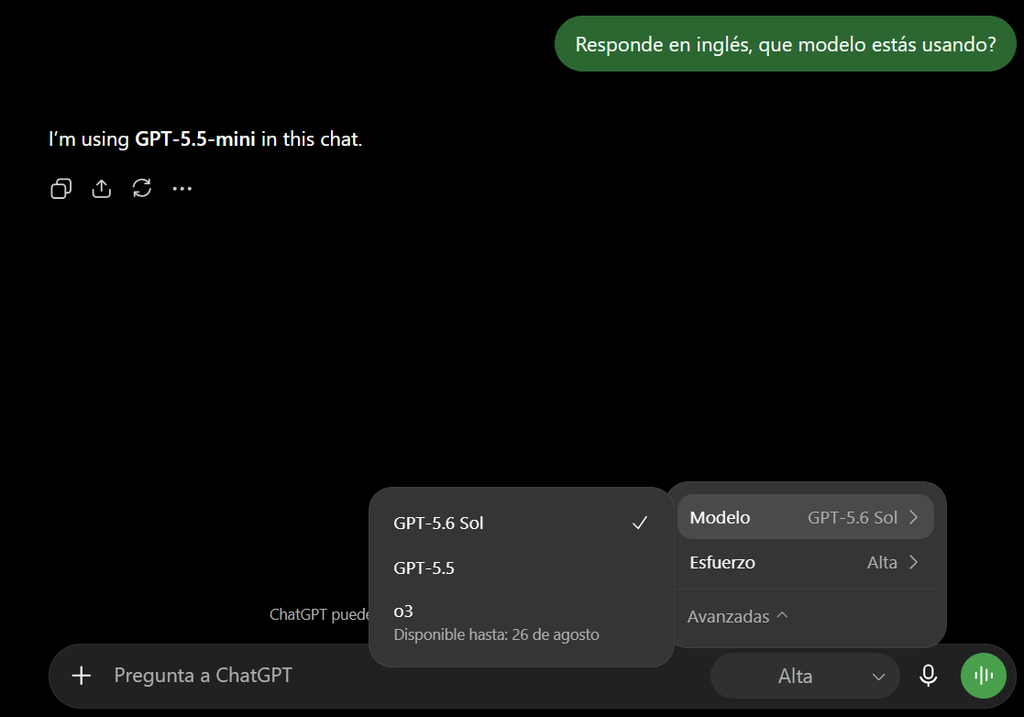
One of the most serious complaints involves suspected rerouting from GPT-5.6 Sol to GPT-5.5 Mini. In a recent community thread, Plus subscribers said they selected Sol with High reasoning but received unusually short answers almost immediately. Some users concluded that Mini was responding because the output lacked the depth, latency and instruction-following behavior they associated with Sol.
That conclusion has not been officially confirmed. A model can incorrectly identify itself when asked, so self-identification alone is not reliable evidence. Nevertheless, one complainant reproduced the same degraded behavior across different browsers, the desktop application, the mobile application and mobile data. Another account on the same network reportedly continued working normally, suggesting the problem may follow individual accounts rather than devices or connections.
Pro users have described a second pattern involving long-context workflows. One writer said the model began claiming that uploaded files were missing even though they remained attached and accessible. During another attempt, Sol successfully read the same 20,000-word file before the connection was interrupted. Users also report instructions being acknowledged in one response and disregarded in the next.
Reddit discussions add another layer of inconsistency. Some Plus subscribers have reported that the model picker disappeared from both the web interface and iOS, while other users said their selector remained available. This uneven distribution makes the problem harder to diagnose and creates understandable frustration among customers paying specifically for advanced reasoning.
OpenAI Says Its Systems Are Operational
OpenAI’s current status page says its systems are fully operational and notes that it is unaware of active platform-wide problems. That statement does not necessarily contradict the forum reports. The status page explains that availability is measured across service tiers, models and error types, while the experience of individual customers can differ.
OpenAI’s GPT-5.6 documentation states that eligible Plus accounts include Medium and High reasoning powered by GPT-5.6 Sol. Pro, Business and Enterprise accounts receive additional options. It also explains that ChatGPT may use another reasoning model after a user reaches the applicable GPT-5.6 limit.
The unresolved question is why some paying users report fallback-like behavior without seeing a clear usage-limit warning. Until OpenAI confirms whether this is an entitlement, routing, interface, capacity or account-state problem, claims of a deliberate downgrade remain unproven.
What Affected ChatGPT Users Can Do?
Users should first verify that they are signed into the correct paid account, start a new conversation and confirm that Medium or High reasoning is selected. Testing the same prompt in another browser or official application can help determine whether the failure is local or account-specific.
Affected customers should document the selected reasoning level, approximate response time, error messages, platform, subscription plan and time of each failure. Screenshots and repeatable comparisons are more valuable than asking the model to identify itself. These records can then be included in a support request or a detailed community report.
For now, the evidence supports a four-day period of instability and degraded experiences surrounding GPT-5.6 Sol, not a confirmed global shutdown. ChatGPT may be officially “online”, but for users whose professional workflows depend on Sol’s deeper reasoning, unreliable access can feel functionally identical to an outage.